
-2.png?width=359&height=449&name=text-image%20module%20desktop%20(4)-2.png)
.jpg?width=276&height=195&name=1-Jul-02-2024-10-07-08-8540-AM%20(1).jpg)
.jpg?width=276&height=196&name=Case%20study%20(21).jpg)
.jpg?width=277&height=196&name=10-2%20(1).jpg)

-2%20(1).png?width=298&height=420&name=text%20image%20tablet%20(31)-2%20(1).png)




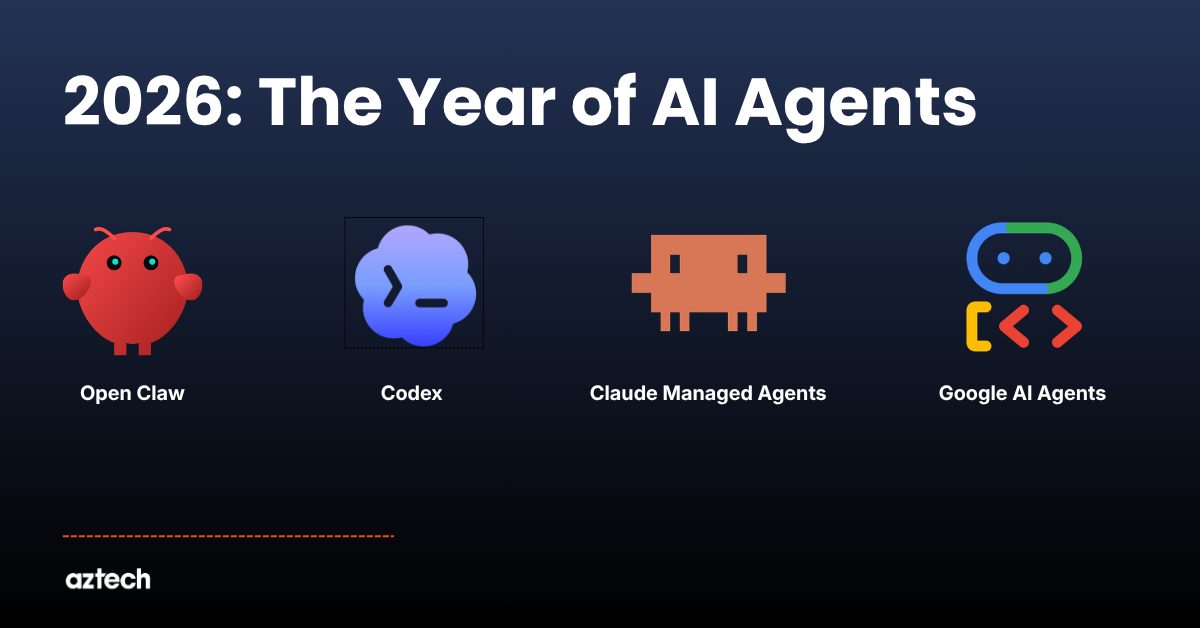
AI agents are autonomous systems that work independently on complex tasks for hours, using tools, writing code, and browsing the web without human supervision.
In 2026, platforms like Anthropic's Claude Managed Agents and the open-source OpenClaw are making this a production reality.
For businesses, the shift from AI-as-tool to AI-as-worker changes everything.
Key Takeaways
- AI agents are different from chatbots.
They work autonomously for hours, use tools, maintain memory, and deliver completed work not just answers. - The market is exploding.
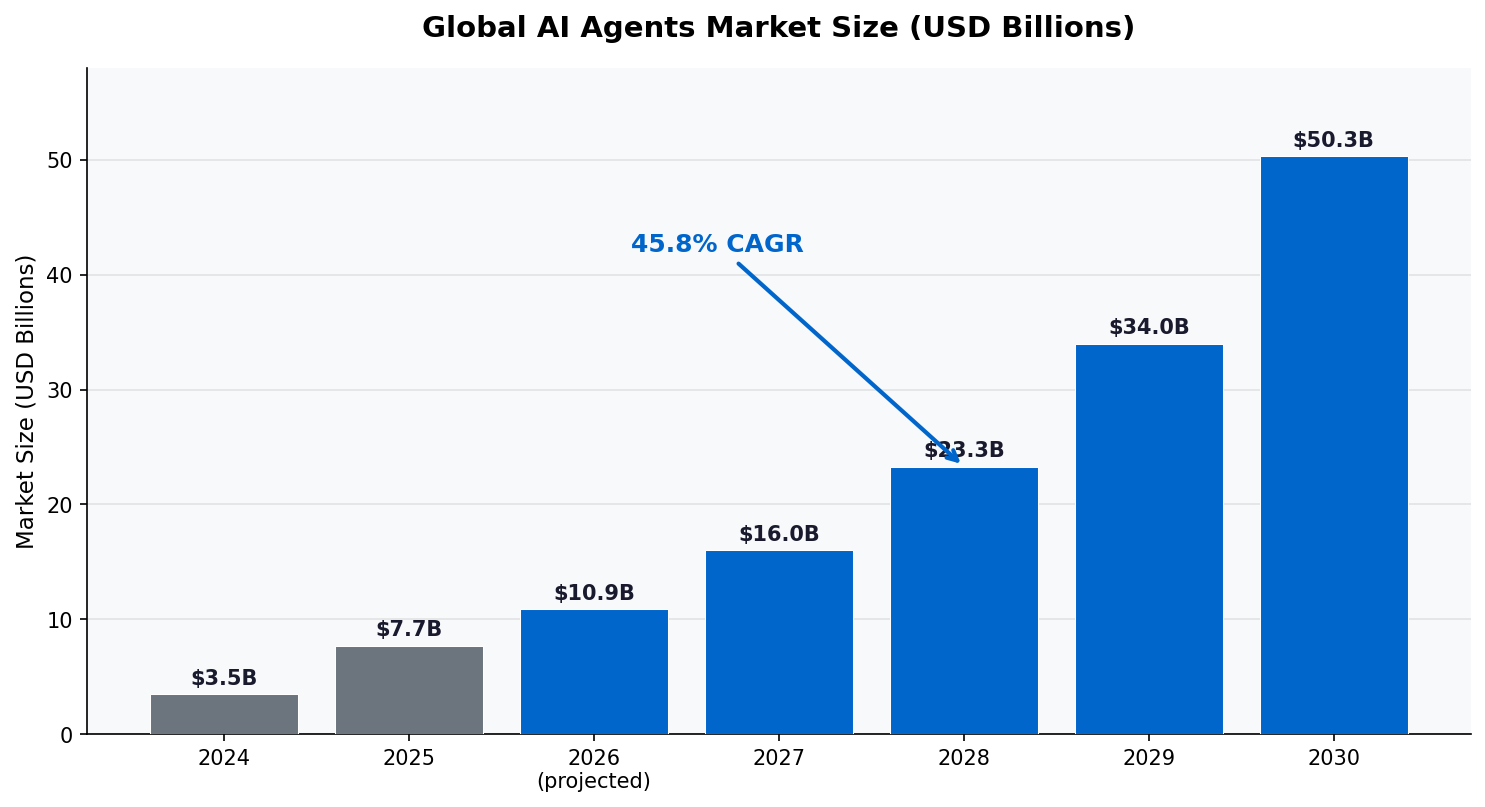
The AI agents market is projected to hit $10.9 billion in 2026, growing at 45.8% CAGR to reach $50.3 billion by 2030. - Two approaches are emerging:
open-source orchestration (OpenClaw, 247,000+ GitHub stars) and enterprise managed infrastructure (Claude Managed Agents). - Anthropic's subscription crackdown on third-party agent harnesses reveals the tension between open platforms and vendor control.
- For businesses:
the organisations that deploy agents on real work in 2026 will build advantages that compound. Start with well-defined, time-consuming tasks.
The Hype Cycle Is Over. The Build Cycle Has Begun.
If you've been watching the AI space even casually over the past few months, you'll have noticed something has shifted.
We're not talking about chatbots anymore. We're talking about agents autonomous AI systems that don't just answer your questions, they actually do the work.
This isn't theoretical. OpenAI's Codex agents are writing production code. Google's building an entire agent ecosystem.
Open-source platforms like OpenClaw are letting people run multi-agent systems across their entire digital lives. And now Anthropic has shipped Claude Managed Agents a hosted service designed to run AI workers autonomously for hours at a time.
We've crossed a line.
The conversation has moved from "what if AI could help with X?" to "here's the agent that did X overnight while I slept."
That's not an incremental change. That's a paradigm shift. We've moved from AI that answers questions to AI that does the work.
And if you're running a business in 2026, you need to understand what that means.
The organisations that figure this out first won't just have a competitive advantage. They'll be playing a different game entirely.
What Are AI Agents (And Why Should You Care)?
Let's start with a simple distinction, because the terminology matters.
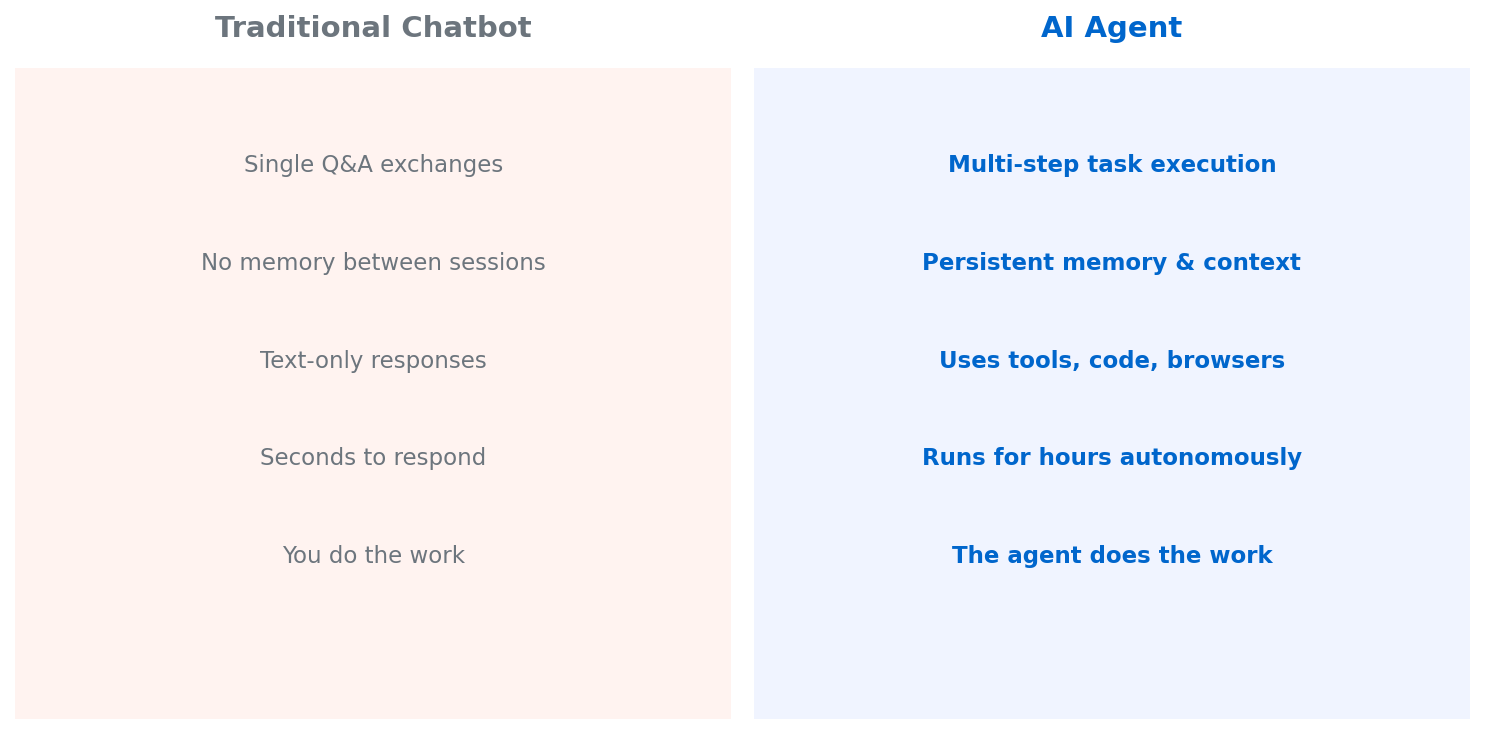
A chatbot answers questions when you ask. You type something, it responds. One question, one answer. When you close the window, it forgets everything.
An agent works autonomously on complex tasks for hours. You give it a goal, it figures out the steps, uses whatever tools it needs, and keeps going until it's done. When you check back in the morning, the work is finished.
Here's the analogy I use: a chatbot is like texting a smart friend for advice.
An agent is like hiring an employee who works overnight and shows you the results in the morning.
What Makes Agents Different
| Capability | Traditional Chatbot | AI Agent |
|---|---|---|
| Memory | Forgets between sessions | Persistent context across days |
| Tools | Text responses only | Web browsing, code execution, file management, API calls |
| Reasoning | Single-turn responses | Multi-step problem decomposition |
| Time horizon | Seconds | Hours or days |
| Autonomy | Responds to each prompt | Works independently toward a goal |
| Output | Text advice | Completed work (code, reports, analyses, actions) |
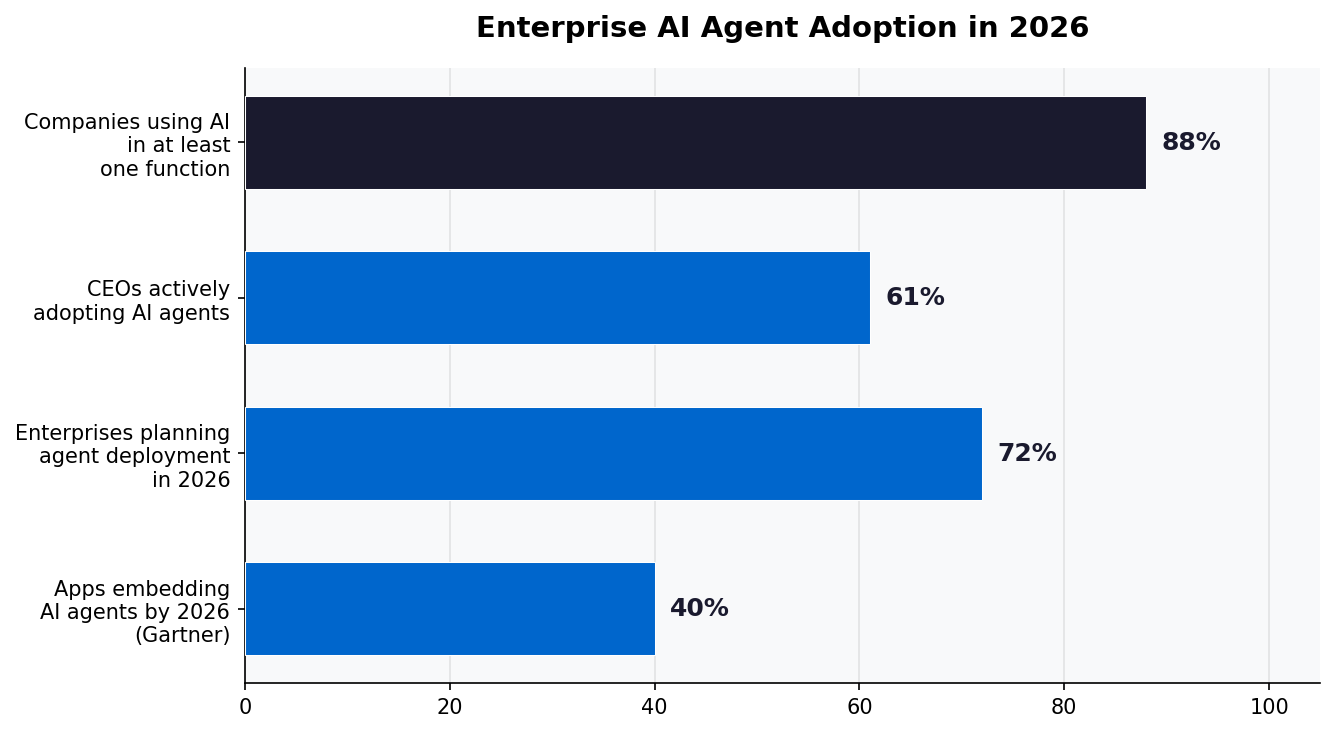
According to Gartner (2026), 40% of enterprise applications will embed task-specific AI agents by the end of this year, up from less than 5% in 2025.
That's not a trend. That's a transformation happening right now.
The Rise of OpenClaw and the Open-Source Agent Movement
One of the most interesting developments in the agent space isn't coming from the big AI labs. It's coming from the open-source community.
OpenClaw is an open-source platform for running AI agents across your life and business. It's not a single model or a closed service..png?width=607&height=253&name=Openclaw%20(1).png)
It's an orchestration layer that lets you build multi-agent systems that can use Claude, GPT, Gemini, or even local models interchangeably.
First published in November 2025, it has become one of the fastest-growing open-source projects in history, amassing over 247,000 GitHub stars (GitHub, April 2026).
The architecture is clever: a skills marketplace with 100+ built-in capabilities, sub-agent orchestration, persistent memory, browser automation via Chrome DevTools Protocol, and connections to your entire digital ecosystem, messaging, calendars, email, and code repositories.
You can spin up an agent to monitor your inbox, another to track GitHub issues, another to handle customer queries, and they all talk to each other.
Why Open-Source Matters for Agents
- Flexibility — you're not locked into one vendor's vision of how agents should work
- No vendor lock-in — swap models, swap providers, run it on your own infrastructure
- Community innovation — thousands of developers building skills and plugins means progress happens faster than any single company can manage
- Transparency — you can see what your agents are doing, audit the code, and understand the behaviour
I've been hands-on with OpenClaw and the broader open-source agent ecosystem, and the signal is unmistakable. When an open-source project gains traction this fast , 247,000 stars in under six months, it tells you the demand is real and the technology is ready.
People aren't waiting for the perfect enterprise solution. They're building their own.
OpenClaw represents a philosophy: agents should be configurable, composable, and owned by the user — not locked inside a single vendor's platform.
As an MSP, that philosophy resonates. Our clients need solutions that integrate with their existing systems, not walled gardens that create new dependencies.
Enter Claude Managed Agents
So that's the open-source side. Now let's talk about what Anthropic just announced.
Claude Managed Agents is a hosted service that runs AI agents autonomously for long-horizon tasks. 
You don't host it, you don't manage infrastructure. You define the task, and Anthropic's platform handles the execution. It's currently in public beta, available to all API accounts.
Anthropic describes it using an OS analogy: they wanted to design "a system for programs as yet unthought of." Stable interfaces on top, implementations change underneath. You don't rewrite your business logic every time the underlying model improves.
The Architecture: Brain, Hands, Session
The key architectural innovation is elegant. They've separated three critical components that, in most agent frameworks, are tangled together:
| Component | What It Does | Why It Matters |
|---|---|---|
| The Brain | Claude's reasoning engine decides what to do next | Stateless harness means it can restart from any point without losing progress |
| The Hands | Isolated sandboxes where code actually runs | Failed containers are "cattle not pets" — replaced automatically |
| The Session | Append-only log of all events, persistent memory | Survives crashes. New instances resume from last recorded event |
Why does this matter? Because each piece can fail independently, scale independently, and be swapped out.
It's like how your phone's apps don't all crash when one app freezes, the operating system keeps them isolated.
What Can These Agents Actually Do?
- Long-running tasks — hours, not seconds
- Persistent file systems — work survives across sessions
- Secure credential isolation — your API keys and passwords are never accessible from the sandbox where code runs
- Web browsing, code execution, MCP tool connections — full access to the tools needed to get work done
Performance That Matters
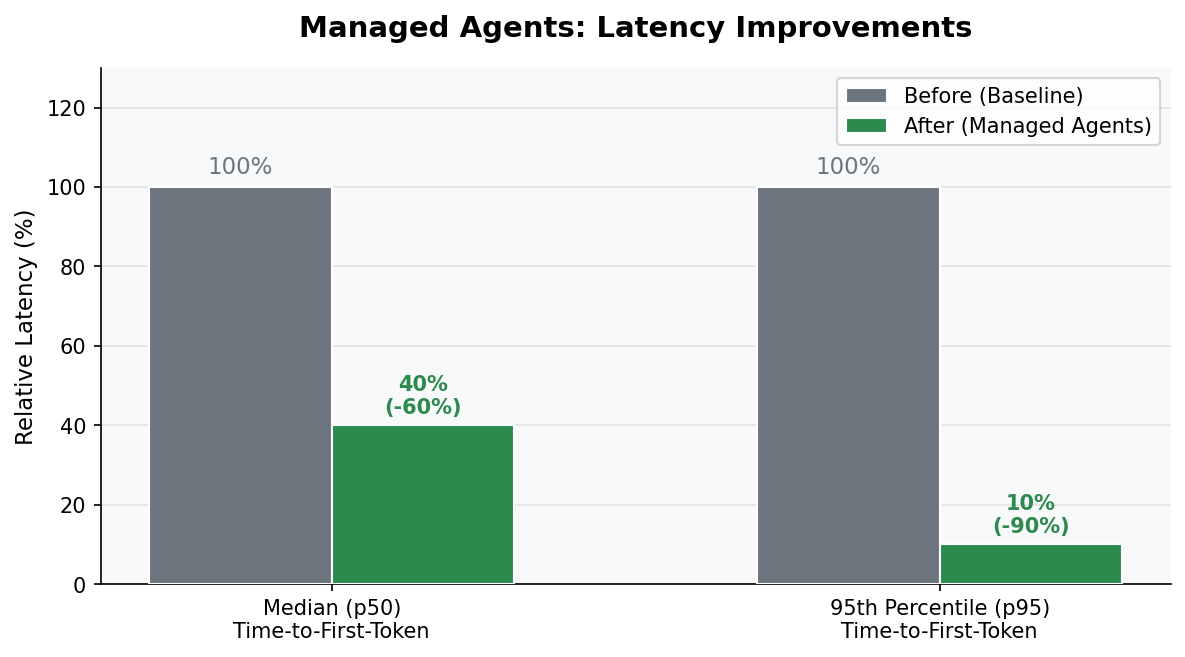
The performance improvements are notable. By decoupling the brain from the hands, Anthropic eliminated mandatory container initialisation for every session (Anthropic Engineering, April 2026):
When you're running agents for hours, startup latency matters. Sessions now begin inference immediately while containers are provisioned only when needed.
Anthropic's credential isolation architecture means agents can use your tools without ever seeing your passwords, credentials live in a separate vault, with a dedicated proxy handling authentication server-side.
That's the kind of design that makes enterprise deployment actually viable.
The Elephant in the Room: Anthropic's Subscription Crackdown
Before we talk about whether these platforms are competitive or complementary, we need to address what happened on 4 April 2026, just days before Managed Agents launched.
The Timeline
OpenClaw creator Peter Steinberger joins OpenAI. Anthropic updates terms to explicitly prohibit subscription OAuth tokens in third-party tools.
Anthropic blocks OpenClaw and all third-party agent harnesses from Claude Pro/Max subscriptions. Over 135,000 OpenClaw instances affected.
Anthropic launches Claude Managed Agents as a hosted alternative for agent workloads.
Here's what happened. Claude Pro ($20/month) and Max ($200/month) subscribers had been using their subscription allowances to power OpenClaw and other third-party agent frameworks.
The problem was economic: a $200/month subscription was running $1,000 to $5,000 worth of agent compute (VentureBeat, April 2026).
Over 135,000 OpenClaw instances were running at the time of the announcement.
Anthropic's Boris Cherny stated that subscriptions were never designed for the kind of continuous, automated demand these tools generate.
Users who wanted to keep running agents needed to switch to pay-as-you-go API keys. Affected subscribers received a one-time credit equal to their monthly plan cost.
Steinberger's response was pointed: "First they copy some popular features into their closed harness, then they lock out open source" (The Next Web, April 2026).
My Take: Understandable, But Poorly Handled
I'm going to be fair here, because both sides have legitimate points.
The economics were unsustainable. When you have 135,000 instances burning through five times more compute than the subscription pricing accounts for, that's not a viable business model.
Anyone running a business understands you can't subsidise a class of usage indefinitely.
But the optics were terrible. Blocking open-source agent harnesses on 4 April and launching your own managed agent platform four days later is, at best, a failure of communications strategy.
At worst, it looks like a calculated platform play: funnel agent usage through your own infrastructure by locking out the alternatives first.
What Anthropic should have done is announce the pricing change and the Managed Agents launch together, with a clear transition period and transparent explanation.
The lesson for businesses watching this play out: be thoughtful about platform dependency.
Whether you're building on OpenClaw or Managed Agents, understand the economic model you're depending on and have contingency plans.
The rules can change quickly.
OpenClaw vs Managed Agents: Competitive or Complementary?
Here's the take: they're more complementary than competitive.
They're solving different problems at different layers.
| Dimension | OpenClaw | Claude Managed Agents |
|---|---|---|
| Layer | Orchestration | Execution |
| Model support | Multi-model (Claude, GPT, Gemini, local) | Single-model (Claude) |
| Hosting | Self-hosted, you control everything | Anthropic-hosted, managed infrastructure |
| Security model | You manage security | Enterprise-grade credential isolation, sandboxing |
| Customisation | Unlimited, open-source | Within Anthropic's framework |
| Best for | Technical teams wanting full control | Enterprises wanting managed, compliant infrastructure |
| Cost model | Free (self-hosted) + API costs | API pricing ($25/$125 per M tokens) |
You could absolutely run Managed Agents as one of the "hands" that an OpenClaw agent orchestrates , the OpenClaw agent handles high-level coordination, and when it needs Claude to run a long-horizon coding task, it hands that off to Managed Agents and waits for the result.
The bigger picture here is more important than the competitive dynamics.
The fact that both open-source AND enterprise players are building agent infrastructure tells you this isn't a fad. This is the new computing paradigm.
What This Means for Your Business
Right. Enough architecture. What does this actually mean if you're running a business?
Here's the concept that's starting to land with businesses I work with: the "AI employee." Agents that work while you sleep and present results in the morning. Not a tool you use. A worker you delegate to.
Practical Use Cases That Are Working Right Now
| Use Case | What the Agent Does | Time Saved |
|---|---|---|
| Overnight code review | Scans pull requests, runs tests, identifies issues, suggests fixes. You review the work in the morning. | 4–6 hours/day per developer |
| Security vulnerability scanning | Runs for hours across your entire codebase, checking dependencies, scanning for known vulnerabilities, generating a comprehensive report. | Days of analyst time per scan |
| Document processing | Reads contracts, compliance reviews, and regulatory filings. Flags issues, prepares summaries, cross-references clauses. | 60–80% of review time |
| Data analysis & reporting | Pulls from multiple sources (CRM, analytics, financial systems), cleans data, runs analysis, generates reports. | Entire analyst workflow automated |
| Customer service workflows | Handles initial triage, researches solutions, drafts responses, escalates complex issues with full context. | 50–70% of Tier 1 volume |
The pattern is the same across all of these: tasks that are time-consuming but well-defined. Work that currently requires a human to sit there for hours, staying focused, following a process.
That's where agents excel.
According to industry analysis (2026), companies adopting agentic AI report an average revenue increase of 6–10%, with up to 37% cost savings in marketing operations and 10–20% uplift in sales ROI. But here's the caveat: Gartner also warns that over 40% of agentic AI projects risk cancellation by 2027 if governance, observability, and ROI clarity are not established early.
The MSP Angle: Managed AI Agents as a Service
For MSPs like us at Aztech, there's another dimension to this story. Clients aren't going to build this themselves.
Most businesses don't have the technical depth to deploy, manage, and integrate AI agents with their existing systems.
They don't have the security expertise to ensure credential isolation is configured properly.
But they're going to need it. And someone needs to deploy it, manage it, integrate it with their existing systems, and train their teams on how to work with it. That's a new service category. And it's landing right now.
At Aztech, we're already building this capability, testing agent deployments internally, identifying the patterns that work, building integration playbooks, and developing the monitoring and governance frameworks that enterprise clients need.
The conversations have shifted from "should we explore AI?" to "which processes do we automate first?"
What I'm telling organisations today
Start with one well-defined process that currently takes a skilled person 4+ hours of focused work.
Something with clear inputs, a documented workflow, and measurable outputs.
Deploy an agent on that single process, learn from what works and what breaks, then expand. The organisations that build this muscle now will compound that advantage with every new deployment.
The Agent Race Is On
2026 will be remembered as the year AI agents went from concept to production. The technology is ready. The infrastructure is being built. The race is on.
The winners won't necessarily be the organisations with the biggest budgets. They'll be the ones willing to experiment deploy agents on real work, learn from what breaks, iterate quickly, and build organisational muscle around working with AI.
Both paths are viable: open-source platforms like OpenClaw for flexibility and control, enterprise services like Managed Agents for security and managed infrastructure.
For many organisations the answer will be a combination of both. What matters isn't which platform you pick. What matters is that you start.
This is the most exciting shift in IT services since the cloud migration wave. I've been doing this for 25+ years, and I haven't seen anything accelerate this fast or carry this much transformative potential.
The hype cycle is done. The build cycle is here. And we're building.
But standing still isn't a choice anymore. Not in 2026.
Ready to Deploy AI Agents in Your Business?
Talk to our team about which processes in your organisation are ready for agent automation. We'll help you identify the right starting point, choose the right platform, and build a deployment plan that delivers measurable results.
Book a Discovery CallFrequently Asked Questions
What are AI agents and how are they different from chatbots?
AI agents are autonomous systems that work independently on complex tasks for hours or days. Unlike chatbots that respond to individual questions, agents break down complex goals, use tools like web browsers and code editors, maintain memory across sessions, and deliver completed work. A chatbot gives you advice. An agent does the work.
What is Claude Managed Agents?
Claude Managed Agents is Anthropic's hosted service for running AI agents autonomously on long-horizon tasks. Launched in public beta in April 2026, it provides managed hosting, automatic scaling, sandboxed code execution, secure credential isolation, and persistent file systems. You define the task, Anthropic handles the infrastructure.
What is OpenClaw?
OpenClaw is an open-source platform for running AI agents, with over 247,000 GitHub stars as of April 2026. It acts as an orchestration layer that lets you build multi-agent systems using Claude, GPT, Gemini, or local models interchangeably. It offers 100+ built-in skills, browser automation, and a community-driven skills marketplace.
Why did Anthropic block OpenClaw from Claude subscriptions?
On 4 April 2026, Anthropic blocked all third-party agent harnesses from Claude Pro and Max subscriptions. Subscribers on $200/month plans were running $1,000–$5,000 worth of agent compute, and over 135,000 OpenClaw instances were operating at the time. Anthropic stated subscriptions were never designed for continuous automated demand.
Should my business use OpenClaw or Claude Managed Agents?
They solve different problems. OpenClaw is an orchestration layer offering multi-model flexibility, open-source transparency, and full control — ideal for technical teams. Claude Managed Agents is an execution layer with enterprise-grade security and managed infrastructure — ideal for organisations wanting vendor support. Many businesses will use both together.
How big is the AI agents market in 2026?
The global AI agents market is projected to exceed $10.9 billion in 2026, growing at 45.8% CAGR to reach $50.3 billion by 2030. Gartner forecasts 40% of enterprise applications will embed AI agents by the end of 2026, up from less than 5% in 2025.
What practical tasks can AI agents handle for my business?
AI agents excel at well-defined, time-consuming tasks: overnight code review and bug fixing, security vulnerability scanning, document processing (contracts, compliance, regulatory filings), multi-source data analysis and reporting, and customer service triage. The common pattern is work that requires hours of focused human attention following a clear process.
Sources
- Anthropic Engineering — Scaling Managed Agents (April 2026)
- OpenClaw — GitHub Repository (247,000+ stars)
- VentureBeat — Anthropic Cuts Off Claude Subscriptions for OpenClaw (April 2026)
- The Next Web — Anthropic Blocks OpenClaw in Cost Crackdown (April 2026)
- TechCrunch — Anthropic Says Subscribers Need to Pay Extra for OpenClaw (April 2026)
- DemandSage — Latest AI Agents Statistics: Market Size & Adoption (2026)

Founder & CEO of Aztech IT Solutions, a UK-based MSP established in 2006. With 19 years of experience in managed IT services, cybersecurity, and digital transformation, Sean helps organisations leverage technology for competitive advantage.
Connect on LinkedIn.png?width=536&name=Blog%20Hero%20Banners%20(6).png)
.png?width=536&name=AI%20Model%20Updates%20%20(1).png)
%20(1).png?width=536&name=Blog%20Hero%20Banners%20(1)%20(1).png)