-2.png?width=359&height=449&name=text-image%20module%20desktop%20(4)-2.png)
.jpg?width=276&height=195&name=1-Jul-02-2024-10-07-08-8540-AM%20(1).jpg)
.jpg?width=276&height=196&name=Case%20study%20(21).jpg)
.jpg?width=277&height=196&name=10-2%20(1).jpg)

-2%20(1).png?width=298&height=420&name=text%20image%20tablet%20(31)-2%20(1).png)



Summary
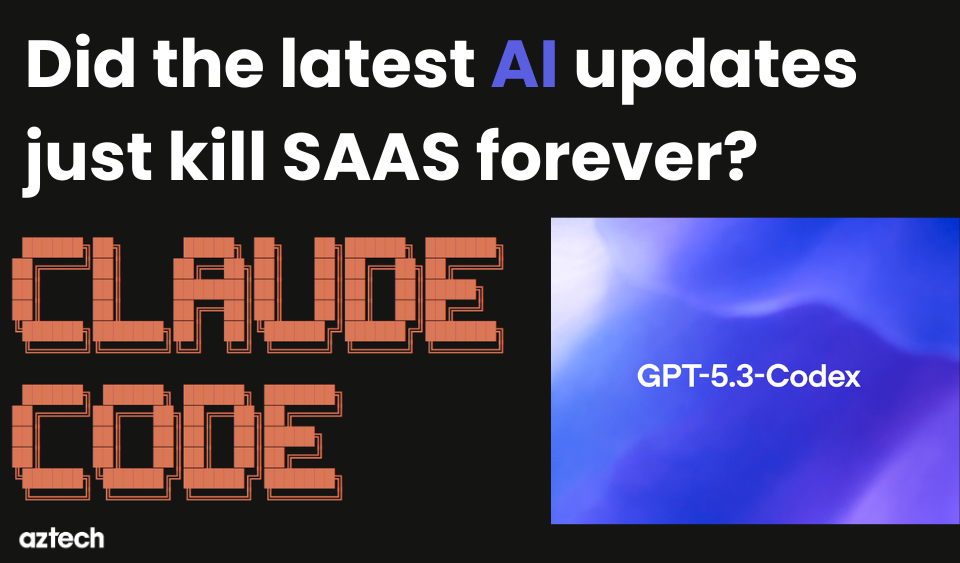
The February 2026 software stock selloff, triggered by Claude Opus 4.6 and GPT-5.3-Codex releases, wiped $285 billion from SaaS valuations. This article explores what's really happening: not SaaS death, but business model disruption.
You'll learn why per-user pricing is dying, how the "luxury software" era enables SMEs to build custom applications in days instead of months, and see a real case study of building production software in 5 days.
Includes practical strategies for IT leaders navigating the shift from traditional SaaS to AI-orchestrated data platforms.
TL;DR
- $285B+ wiped from software stocks in 48 hours following Claude Opus 4.6 and GPT-5.3-Codex releases on February 5, 2026.
- SaaS isn't dead, but per-user pricing models and feature bloat are dying.
- Custom development costs collapsed 90%+ (£50,000 → £5,000, 3 months → 5 days).
- "Luxury software" era: SMEs can now build bespoke applications tailored to exact workflows.
- Real case study: Aztech built myaiblueprint.ai in 5 days using Claude Code.
- The shift: SaaS evolves from application layer to data layer, with AI agents orchestrating outcomes.
- Generic CRUD apps are vulnerable, vertical SaaS with regulatory moats survive.
Key Market Stats
- $285B to $830B wiped from software market in 48 hours (Bloomberg).
- Thomson Reuters -16%, Salesforce -27% YTD, LegalZoom -20% in single session (Globe and Mail).
- Goldman Sachs warns of multi-year SaaS decline comparable to newspaper industry's 95% collapse (IndexBox).
- 90% reduction in custom development costs using AI coding tools like Claude Code and GPT-5.3-Codex.
- 40+ AI workshops delivered using Aztech's custom-built platform since December 2025.
Is SaaS Dead? Not Completely, But the Business Model Is Broken
Is SaaS dead? Not completely, but on February 5th, 2026, when Anthropic released Claude Opus 4.6 and OpenAI countered with GPT-5.3-Codex within hours, the business model that powered two decades of software growth faced an existential reckoning. The traditional per-user pricing model, one-size-fits-all feature bloat, and expensive customisation are dying. What's emerging is something far more interesting.
The market's verdict was swift and brutal. Within 48 hours, software companies shed $285 billion to $830 billion in market value. Thomson Reuters plunged 16%. Salesforce down 27% year-to-date. LegalZoom collapsed 20% in a single session. Goldman Sachs strategists warned of a "multi-year decline" comparable to the newspaper industry's 95% collapse between 2002 and 2009.
Investors are calling it the "SaaSpocalypse" – the moment when AI coding tools stopped being helpful assistants and started threatening entire software categories.
But here's what the market panic misses: This isn't just disruption. It's democratisation.
As the founder of a 100-person MSP that's been navigating technology shifts since 2006, I'm not watching this unfold from the sidelines. I'm actively rebuilding how we work. Last month, we built a production-ready application in five days using Claude Code – something that would have cost £50,000 and taken three months a year ago. We're questioning every SaaS subscription, every workflow, every process: "Could we build exactly what we need instead of adapting to what exists?"
The answer, increasingly, is yes. And that changes everything.
This isn't theoretical analysis. This is a founder's perspective from the front lines of the shift, including the real-world case study of what we built, why it matters, and what it means for organisations trying to navigate the chaos.
A Founder's Perspective: What This Really Means
Let me be direct: SaaS isn't dead. But the business model that made it a $300 billion industry is fundamentally broken.
I've been running Aztech for nearly two decades. I've seen technology shifts before. The move to cloud. The mobile revolution. The remote work transformation. Each time, there's initial panic, then adaptation, then a new normal that's better than what came before.
This feels different. Not because AI is replacing software, but because it's unbundling the value proposition that made SaaS dominant in the first place.
The Old SaaS Bargain (Now Breaking)
For the past 20 years, the deal was simple:
- You pay £50-100 per user, per month
- You get a feature-rich platform that does 100 things
- You use maybe 20 of those features
- You tolerate the 80% you don't need because building custom was impossibly expensive
The math worked because custom development cost £50,000-£500,000 and took months. Better to pay for bloated software than build from scratch.
That equation just collapsed.
What Changed on February 5th
When I first used Claude Opus 4.6 and GPT-5.3-Codex, my immediate thought wasn't "this will replace SaaS." It was: "Why am I paying for software I'm adapting my business to fit?"
These tools don't just write code faster. They fundamentally change the economics of custom development:
- What cost £50,000 → Now costs £5,000
- What took 3 months → Now takes 3-5 days
- What required a dev team → Now needs one technical person + AI
Suddenly, the "build vs. buy" calculation flips. Not for everything, but for enough workflows to terrify SaaS investors.
My Take: SaaS Isn't Dying, It's Evolving
Here's where I disagree with the "SaaSpocalypse" panic sellers:
What's dying:
- Per-user seat pricing
- One-size-fits-all feature bloat
- The idea that complex UIs are inherently valuable
- Expensive customisation as a moat
What's emerging:
- SaaS as a data layer rather than an application layer
- AI agents orchestrating across multiple platforms
- Outcome-based pricing instead of seat-based
- Platforms that enable building on top of them (ironically, the opposite of walled gardens)
To be clear: Some SaaS companies will die. Generic project management tools, basic CRM platforms without deep vertical expertise, simple workflow automation that AI agents can replicate in minutes. If your entire value proposition is "we have a nice UI for CRUD operations," you're in trouble. But that's not most SaaS. The valuable ones will adapt, and I'll break down exactly which categories are at risk versus which will thrive later in this article.
Microsoft's Satya Nadella nailed it in his recent podcast with Bill Gurley: "Traditional CRUD applications – your basic create, read, update, delete functions – will increasingly migrate to an agentic layer.
The applications become databases, and the AI becomes the interface."
Think about that. Your CRM doesn't disappear. It becomes a smart database that AI agents query and update via natural language instructions instead of you clicking through 47 screens to update a customer record.
How I'm Rethinking Everything
Since getting access to these tools, I've been asking a single question about every workflow at Aztech:
"If we were starting from scratch today, would we build this differently?"
The honest answer is almost always: Yes.
- Our client onboarding process? Custom workflow, not a bloated PSA module we use 30% of
- Our internal documentation? Bespoke knowledge base, not Confluence with 200 features we ignore
- Our sales pipeline? Exactly what we need, not Salesforce minus the £200/month we're not using
I'm not suggesting we cancel everything and code from scratch.
That's the panic talking. But I am actively rebuilding workflows where the ROI is obvious and the AI tools make it viable.
The Shift That Matters
The future isn't "AI replaces SaaS." It's:
Old Model:
Pay for seats → Navigate complex UIs → Manual workflows → Hope you're using enough features to justify cost
New Model:
AI agents access data layers → Orchestrate outcomes → Pay for results (API calls, outcomes, value delivered)
Example: You don't need 10 Salesforce seats at £50/month if an AI agent can handle prospect research, data entry, and pipeline updates, leaving 2 sales reps to focus on relationships and closing deals.
The value moves from the interface to the data. Companies with rich, well-structured data and accessible APIs will thrive.
Those charging per-seat for glorified CRUD operations will struggle.
This is why I'm excited rather than panicked. For the first time in my career, SMEs can have software that works exactly how they need it to work, not software they adapt their business to fit.
The "Luxury Software" Era for SMEs
Here's the dirty secret of SaaS that nobody talks about: SMEs have been subsidising enterprise features they'll never use.
You pay £5,000/month for Salesforce. You use the pipeline, contact management, and basic reporting. That's maybe 20% of what you're paying for. The other 80%? Enterprise territory management, advanced forecasting, complex approval workflows, integrations with systems you don't have.
But you tolerate it because the alternative, until now, was worse.
The Old Calculation (That No Longer Applies)
Option A: Buy SaaS
- £60,000/year for Salesforce
- Get 100 features
- Use 20
- Spend weeks trying to configure it to match your workflow
- Eventually adapt your business to fit the software
Option B: Build Custom
- £50,000-£150,000 upfront development
- 3-6 months timeline
- Ongoing maintenance costs
- Risk: What if requirements change?
The math was simple: Better to pay for bloat than build from scratch.
That calculation just became obsolete.
The New Reality
With Claude Opus 4.6 and GPT-5.3-Codex, custom development costs have collapsed by 90%+:
- £50,000 → £5,000
- 6 months → 1 week
- Dedicated dev team → One technical person with AI tools
- Ongoing maintenance → AI handles updates and iterations
Suddenly, it's not "build vs. buy" anymore. It's "buy generic vs. build exactly what you need."
The Bespoke Suit Analogy
Think about clothing:
Off-the-Rack (Traditional SaaS):
- One size fits most
- Covers the basics
- Good enough
- You adapt to what's available
Bespoke Tailoring (Custom AI-Built Software):
- Designed for your exact measurements
- Every detail matches your preferences
- Perfect fit
- Built around how you actually work
For decades, only enterprises could afford "bespoke software." Custom ERPs, proprietary systems, dedicated development teams.
SMEs got "enterprise software at SME prices" which really meant "compromise software at prices you can barely afford."
What "Luxury Software" Means
I'm calling this the Luxury Software era – when SMEs can finally have applications built exactly for their workflows, not generic tools they bend their business to fit.
Examples from organisations we're working with:
Instead of: HubSpot with 200 features (using 30)
Build: Custom lead qualification system that integrates with your exact process
Instead of: Monday.com project management (adapting your workflow to theirs)
Build: Bespoke project tracker matching how your team actually works
Instead of: Zendesk support portal (£££ per agent)
Build: Custom client portal with exactly the features your customers need
The kicker? Each of these custom builds costs less than 12 months of the SaaS subscription they're replacing.
The Question That Changes Everything
For every SaaS tool you're paying for, ask:
"If I could have software that does exactly what I need and nothing else, for less than I'm currently paying, would I want it?"
If the answer is yes, that's now a viable option.
Not for everything. Mission-critical systems with complex integrations, regulatory requirements, and years of accumulated business logic? Keep those. But for the workflow tools frustrating you because they almost-but-not-quite fit your needs?
Build it.
Why This Matters Beyond Cost
It's not just about saving money. It's about competitive advantage.
When your CRM, project management, and client portal are custom-built for your exact process, you're not constrained by what the software allows. Your software enables your competitive differentiation rather than forcing you into the same workflows as every competitor using the same tools.
That's the shift SaaS investors are panicking about. Not that software disappears, but that the constraint of "we have to use what exists" is gone.
In the next section, I'll show you exactly how this works with a real example: the application we built in five days that replaced a process we couldn't find suitable SaaS for at any price.
Case Study: How We Built myaiblueprint.ai in 5 Days
Let me show you exactly what "luxury software" looks like in practice.
The Problem We Couldn't Buy a Solution For
By late 2025, Aztech was running 3-4 AI Discovery workshops per week. Demand was exploding. Every client wanted to understand how AI could transform their operations, but they needed structure, not just conversation.
Our challenge:
- Gather client-specific context before workshops (industry, pain points, existing tech stack)
- Guide them through a structured AI readiness assessment during sessions
- Generate tangible deliverables (roadmap, implementation plan, prioritised opportunities)
- Deliver professional outputs they could take to their board
We looked at existing SaaS options:
Survey tools (Typeform, SurveyMonkey): Collected data but couldn't generate strategic outputs
Consulting platforms (Deltek, Kantata): Overkill for this specific workflow, £££££
Project management tools (Monday, Asana): Wrong use case entirely
Custom forms + manual analysis: Time-consuming, inconsistent, didn't scale
The perfect solution didn't exist at any price point. So we built it.
What We Built (and How Fast)
Timeline: 5 days from concept to production
Team: One developer + Claude Opus 4.6
Cost: Under £5,000 (would've been £50,000+ traditionally)
Technology: Next.js, React, PostgreSQL, hosted on Vercel
What it does:
1. Pre-Workshop Assessment
-
- Clients complete structured questionnaire about their business
- AI analyses responses and identifies opportunity areas
- Generates preliminary insights for workshop facilitator
.png?width=1366&height=768&name=AI%20Blueprint%20Screenshots%20(1).png)
2. Live Workshop Interface
-
- Guides facilitator through discovery framework
- Captures decisions and priorities in real-time
- Maps client needs to AI capabilities
3. Automated Deliverable Generation
-
- Creates a personalised AI roadmap based on workshop inputs
- Prioritises opportunities by impact and feasibility
- Generates implementation timeline with milestones
- Produces professional PDF report clients can share internally
.png?width=1366&height=768&name=AI%20Blueprint%20Screenshots%20(2).png)
4. Post-Workshop Tracking
-
- Tracks implementation progress
- Stores client-specific AI strategy in structured format
- Enables follow-up engagement based on roadmap status
.png?width=607&height=341&name=AI%20Blueprint%201%20(1).png)
What This Would've Cost Traditionally
Traditional development estimate:
- Requirements gathering: 1 week
- Design: 2 weeks
- Development: 8-10 weeks
- Testing: 2 weeks
- Total: 3-4 months, £50,000-£75,000
Actual cost with AI tools:
- 5 days
- £4,500 (developer time + infrastructure)
- 90% faster, 90% cheaper
The Business Impact
Since launching in December 2025:
- 40+ workshops delivered using the platform
- 6 hours saved per workshop in manual report generation
- Consistent quality in deliverables regardless of which team member facilitates
- Client satisfaction increase from tangible, professional outputs
- Lead generation tool: The platform itself demonstrates our AI capability
But the real value?
We have software that works exactly how we work. No compromising our process to fit a generic tool. No paying for features we don't need. No "sorry, the software doesn't support that workflow."
The Kicker
We now offer this as a white-label service to other consultancies running AI workshops. £500/month subscription.
Three months ago, we were a potential customer for workflow SaaS. Now we're competing with it.
That's the SaaSpocalypse from the inside.
Try it yourself: myaiblueprint.ai
.png?width=1366&height=768&name=AI%20Blueprint%20Screenshots%20(3).png)
(Note: The workshop platform itself is for Aztech clients and partners, but the landing page demonstrates the capability and approach)
What Dies, What Survives & The Three-Layer Future
Not all SaaS is created equal. The selloff treats every software company the same, but that's panic, not analysis. Let me break down exactly which categories face genuine existential risk and which will emerge stronger.
💀 What Dies
1. Generic Horizontal CRUD Applications
If your value proposition is "nice UI for basic database operations," you're vulnerable:
- Basic CRM tools (contact management, simple pipelines)
- Simple project management (task lists, kanban boards without deep workflow logic)
- Basic accounting software (invoicing, expense tracking without regulatory depth)
- Workflow automation (Zapier-style connectors AI agents can replicate)
Why they're at risk: AI agents can handle these workflows natively. Creating a contact, updating a deal stage, moving a task, generating an invoice. These are exactly the "CRUD operations" Nadella referenced.
Example: A basic CRM charging £50/seat for contact management, pipeline tracking, and email logging. An AI agent with access to your email and calendar can handle 80% of this for pennies per month in API costs.
2. Per-Seat Pricing Models Without Adjustment
Even valuable platforms are vulnerable if they cling to per-user pricing when AI reduces human seat requirements:
- Salesforce charging for 50 sales seats when AI handles prospecting and data entry for 40 of them
- Support platforms charging per agent when AI resolves 60% of tickets
- Collaboration tools charging per user when AI agents become "users"
The software might be valuable. The pricing model is dead.
3. Feature-Bloated "All-in-One" Platforms
Software that tried to be everything to everyone:
- Comprehensive suites where customers use 20% of features
- Platforms charging premium prices for capabilities most users ignore
- Tools requiring extensive training because of complexity customers don't need
Why they die: The "luxury software" alternative is now viable. Why pay for 100 features when you can build the 20 you need?
✅ What Survives
1. Deep Vertical SaaS with Regulatory Moats
Software embedded in compliance frameworks and industry-specific requirements:
- Healthcare platforms (HIPAA compliance, clinical workflows, EMR integration)
- Financial services software (FCA/SEC compliance, audit trails, regulatory reporting)
- Manufacturing systems (safety protocols, equipment integration, supply chain complexity)
- Legal practice management (client privilege, trust accounting, court filing integration)
Why they survive: Regulatory compliance and industry-specific workflows take years to replicate correctly. AI accelerates development, but it doesn't eliminate the need for deep domain expertise and certification.
2. Platforms with True Network Effects
Software where value comes from the network, not just the features:
- Marketplaces (buyers and sellers both create value)
- Communication platforms (everyone needs to be on the same one)
- Industry-specific networks (professional communities, data sharing ecosystems)
Why they survive: AI can't replicate network effects. The value is in the connections, not the interface.
3. Data Platforms That Embrace AI Orchestration
SaaS companies pivoting from "application with UI" to "data platform with APIs":
- Salesforce building AI agent access layers
- HubSpot creating API-first workflows
- Stripe enabling AI-driven payment orchestration
Why they survive: They're not fighting the shift, they're enabling it. They become the data layer AI agents orchestrate across.
🚀 What Thrives
1. AI-Native Platforms Built for Agent Orchestration
New entrants designed from day one for AI workflows:
-
- Tools built API-first, UI-second
- Platforms charging for outcomes, not seats
- Services enabling AI agents as first-class users
2. Vertical Experts Adding AI Capabilities
Industry-specific platforms that maintain their moat whilst adding AI:
-
- Medical practice software with AI diagnosis assistance
- Legal research platforms with AI brief generation
- Accounting systems with AI tax optimisation
They combine irreplaceable domain expertise with AI efficiency.
3. Platforms Enabling "Luxury Software" Development
Ironically, tools that help SMEs build their own solutions:
-
- Low-code platforms that AI can use
- API-first infrastructure services
- Development tools optimised for AI coding
They win because they enable the shift rather than resist it.
Understanding the Shift: The Three-Layer Future
Here's the architectural change driving everything above.
The old stack looked like this:
[Human Users] → [SaaS Application UI] → [Application Database]
You paid per user. The application controlled everything. Value was in the interface.
The new stack looks like this:
[AI Agents] → [Orchestration Layer] → [Data Layer] → [Multiple Systems]
Let me break down each layer:
Layer 1: Data (The Foundation)
This is where your actual business information lives:
- Customer data (names, interactions, purchase history)
- Financial data (invoices, payments, budgets)
- Operational data (tickets, projects, timelines)
- Product data (inventory, specifications, pricing)
The shift: This layer has value independent of the application. Your customer data is valuable whether it's in Salesforce, a custom database, or a spreadsheet. What matters is that it's structured, accessible, and accurate.
Companies with high-quality data in accessible formats (APIs, databases, structured files) have the foundation for the AI era. Those with data locked in proprietary formats or poorly maintained are vulnerable.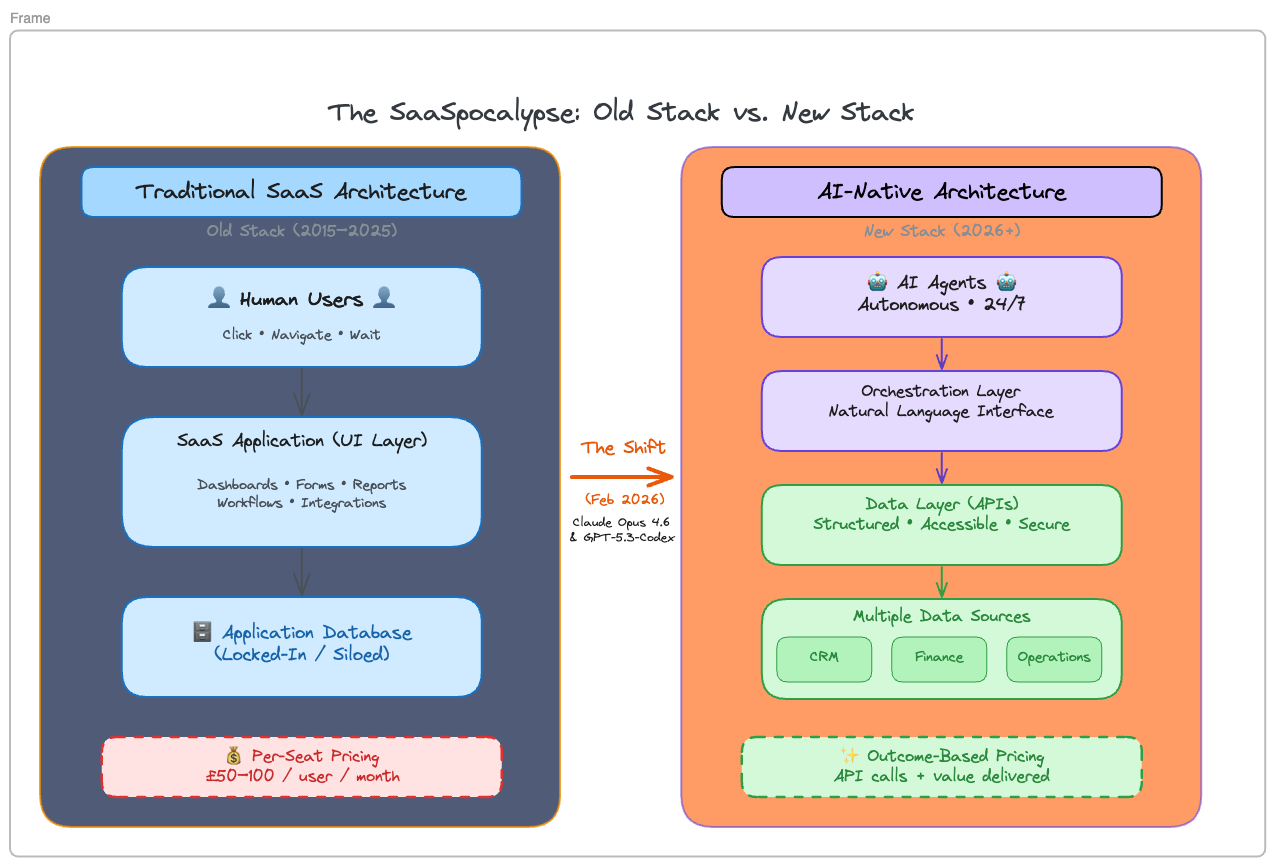
Layer 2: Applications (The Interface - Evolving)
Today, this is what we think of as "SaaS":
- Dashboards for humans to view data
- Forms for humans to input information
- Reports for humans to analyse trends
- Workflows humans click through
The shift: Applications are evolving from "human interfaces" to "data access layers."
Your CRM doesn't need a beautiful dashboard if an AI agent can query it via natural language. What matters is:
- Clean APIs for programmatic access
- Structured data models
- Integration capabilities
- Reliable uptime and security
The UI becomes less important. The data accessibility becomes everything.
Layer 3: AI Agents (The Orchestration - New)
This is the layer that's terrifying SaaS investors:
Old workflow:
- Human opens Salesforce
- Clicks through 6 screens
- Updates customer record
- Generates report
- Emails to team
New workflow:
-
- Human: "Update the customer record and send the team a summary"
- AI agent queries Salesforce API, updates data, generates summary, sends email
- Done
The implications:
-
- You don't pay for Salesforce "seats" the AI agent uses
- You pay for API calls (pennies vs. pounds)
- One human can orchestrate work across multiple systems via AI agents
- The "interface" is natural language, not clicking through forms
Why This Explains the Winners and Losers
Generic CRUD apps die because Layer 3 (AI agents) can handle those operations directly. Why pay for Layer 2 (the application UI) when you don't need humans clicking through it?
Deep vertical platforms survive because Layer 1 (data) in those industries requires domain expertise, compliance, and certification. The AI agent still needs somewhere reliable to store healthcare data with HIPAA compliance.
Data platforms thrive because they focus on Layer 1 (quality data) and enable Layer 3 (AI access), rather than defending Layer 2 (human UIs) that are becoming less relevant.
The Practical Implication
In 2027, successful organisations will:
- Invest in data quality (Layer 1) because that's the foundation AI agents need
- Choose applications based on API access (Layer 2) not UI beauty
- Deploy AI agents for orchestration (Layer 3) rather than adding human seats
The value shifts from the interface to the data. Companies charging per-seat for interfaces humans don't need anymore are fighting a losing battle.
Those building high-quality data platforms with AI-friendly access are building the infrastructure for the next decade.
That's not the death of SaaS. That's its evolution.
What This Means for Your Organisation
If you're responsible for technology strategy, the SaaSpocalypse creates both risk and opportunity. Here's your practical roadmap for navigating the shift.
Immediate Actions (This Quarter)
1. Audit Your SaaS Portfolio for AI-Replaceable Functions
Go through every SaaS subscription and ask:
-
- What workflows does this handle?
- How many of those could an AI agent replicate?
- Are we paying per-seat for features AI could handle?
- Is this solving a unique problem or basic CRUD operations?
Example: Your team uses Asana for task management. Basic task creation, status updates, and notifications? AI-replaceable. Complex project dependencies with client-specific approval workflows? Less so.
Create three buckets:
-
- Keep (for now): Mission-critical, deep integration, regulatory requirements
- Watch: Vulnerable to AI replacement, evaluate alternatives quarterly
- Test Alternatives: Clear candidates for custom build or AI agent replacement
2. Identify One "Luxury Software" Opportunity
Don't try to rebuild everything. Pick one frustrating workflow where:
-
- You're paying for bloated SaaS you're adapting to fit
- The workflow is specific to your business
- Custom development would deliver clear ROI
Questions to ask:
-
- What would the perfect version of this tool do for us?
- How much are we currently paying for the imperfect version?
- Could we build exactly what we need for less than 12 months of current spend?
3. Test AI Coding Tools on Non-Critical Workflows
Before committing to major changes, experiment:
-
- Build an internal tool with Claude Code or GPT-5.3-Codex
- Start with something low-risk (internal dashboard, reporting tool, data processing script)
- Learn what's realistic vs. hype
Budget: £5,000-£10,000 for proof of concept. If it saves 10 hours/month of manual work, ROI is immediate.
4. Renegotiate SaaS Contracts (They're Motivated)
SaaS vendors are terrified. Use that:
-
- Identify contracts up for renewal in next 6 months
- Request pricing concessions or seat reductions
- Ask about AI-driven pricing models or API access tiers
- Don't threaten to leave unless you mean it, but do mention you're evaluating alternatives
Many vendors will discount 20-30% rather than lose customers in this environment.
Medium-Term Strategy (6-12 Months)
1. Map Your Data Architecture
Ask where critical business data actually lives:
-
- Customer data (CRM, email, spreadsheets?)
- Financial data (accounting system, ERPs?)
- Operational data (tickets, projects, timesheets?)
- Product data (inventory, specifications, pricing?)
Then assess:
-
- Is it accessible via APIs?
- Is it well-structured or messy?
- Could AI agents query it reliably?
- Do we own it or is it locked in proprietary formats?
The goal: Understand your Layer 1 (data foundation) because that's what matters in the AI era.
2. Build Internal AI Literacy
Your leadership team needs to understand:
-
- What AI coding tools can and can't do
- The economics of custom development vs. SaaS
- The three-layer architecture (data, apps, AI agents)
- Where your organisation is vulnerable vs. positioned well
Practical steps:
-
- Run internal workshop on AI capabilities (we can help with this)
- Test AI tools with cross-functional team
- Share learnings across departments
- Create evaluation framework for "build vs. buy" decisions
3. Plan Hybrid Approach
You won't replace everything. Successful strategy is:
Keep:
-
- Mission-critical systems with deep integrations
- Vertical SaaS with regulatory moats
- Platforms with network effects you depend on
Build Custom:
-
- Frustrating workflows where SaaS doesn't fit
- Competitive differentiators unique to your business
- Internal tools where "good enough" isn't good enough
Deploy AI Agents:
-
- CRUD operations across existing systems
- Data entry and updates
- Report generation and analysis
- Workflow orchestration between platforms
4. Start Small, Learn Fast
Don't bet the company on unproven approaches:
-
- Build 2-3 custom tools in 6 months
- Deploy AI agents for specific workflows
- Measure actual ROI vs. assumptions
- Iterate based on what works
Long-Term Planning (12-24 Months)
1. Prepare for Outcome-Based Pricing
Per-seat pricing is dying. What's replacing it:
-
- API/consumption pricing: Pay for usage, not seats
- Outcome-based pricing: Pay for results delivered
- Platform + agent models: Base platform fee + AI agent costs
Your strategy:
-
- Favour vendors moving to flexible pricing
- Build cost models that account for AI agent usage
- Negotiate contracts with consumption clauses
2. Invest in Data Quality and Accessibility
In the three-layer future, your competitive advantage is:
-
- Data quality: Accurate, up-to-date, well-structured
- Data accessibility: APIs, integrations, AI-friendly formats
- Data governance: Security, compliance, ownership clarity
Companies with excellent data and poor UIs will outcompete those with beautiful UIs and poor data.
3. Position for Data + AI Agent Architecture
By 2027-2028, successful organisations will:
-
- Own their data layer (not locked in proprietary systems)
- Use SaaS as data platforms (not application suites)
- Deploy AI agents for orchestration (not just automation)
Start now:
-
- Prioritise API-first vendors
- Move data to accessible formats
- Build competency in AI agent deployment
- Reduce dependence on human-UI-centric workflows
4. Consider Custom Development for Core Differentiators
If a workflow creates competitive advantage, ask:
"Should we own this completely?"
Your unique sales process, client onboarding, service delivery, reporting. These aren't commodities. Why use commodity software for them?
With AI development costs at 10% of traditional levels, custom-building competitive differentiators is newly viable for SMEs.
The Real Question
In 2027, will you be:
A) Paying for software seats your AI agents don't need, adapting your business to fit generic tools, wondering why competitors are more agile?
Or
B) Orchestrating bespoke systems that deliver exactly what you require, with AI agents handling mundane tasks and humans focused on strategy and relationships?
The SaaSpocalypse is forcing this choice sooner than anyone expected.
How Aztech Can Help
We're living this transformation ourselves:
-
- Built myaiblueprint.ai to replace workflow we couldn't buy
- Evaluating every internal SaaS subscription through this lens
- Deploying AI agents across our operations
- Learning what works (and what doesn't) in real time
Our AI Discovery workshops help organisations:
-
- Identify AI-replaceable SaaS opportunities
- Map data architecture for AI readiness
- Create practical roadmap for hybrid approach
- Pilot custom development projects with AI tools
We're not consultants theorising about the future. We're MSP operators rebuilding our tech stack and helping clients do the same.
Visit myaiblueprint.ai to see our approach or contact us to discuss your specific situation.
The Opportunity Disguised as Chaos
The SaaSpocalypse looks like destruction. $285 billion wiped from software valuations in 48 hours. Analysts comparing it to the newspaper industry's 95% collapse. Panic selling across the sector.
But step back from the chaos and see what's actually emerging.
For two decades, SMEs have been forced to adapt their businesses to fit generic software. Pay for 100 features, use 20, tolerate the frustration because building custom was impossibly expensive. Accept per-user pricing even when it didn't match value delivered. Compromise competitive workflows to match what the software allowed.
That constraint is gone.
Claude Opus 4.6 and GPT-5.3-Codex didn't just make coding faster. They democratised custom software development. For the first time, SMEs can have applications built exactly for their workflows, not generic tools they bend their business to fit.
This isn't the death of SaaS. It's the death of the lazy SaaS business model: charge per seat, add features until the product is bloated, make customisation expensive, lock customers into contracts, hope they don't realise they're paying for 80% they don't use.
What survives and thrives:
-
- Vertical experts with regulatory moats
- Platforms embracing the data-layer model
- Services enabling AI orchestration
- Companies that compete on data quality and accessibility, not UI complexity
What dies:
-
- Generic CRUD apps without differentiation
- Per-seat pricing without flexibility
- Feature bloat as a retention strategy
- Walled gardens that resist AI access
The real story isn't "AI kills software." It's "SMEs can finally have software that works exactly how they need it."
That's not apocalypse. That's opportunity.
Your Move
In 2027, will you still be paying for software seats your AI agents don't need, adapting your competitive workflows to generic tools, wondering why more agile competitors are pulling ahead?
Or will you be orchestrating bespoke systems delivering exactly what you require, with AI agents handling mundane tasks and your team focused on strategy, relationships, and outcomes that actually differentiate your business?
The SaaSpocalypse is forcing this choice sooner than anyone expected.
The winners will be organisations that embrace AI as a tool for building competitive advantage, not just cutting costs. That maintain operational discipline whilst exploiting new capabilities. That invest in data quality because they understand it's the foundation everything else builds on.
We're rebuilding our tech stack. We're helping clients do the same. The question is: are you ready to rethink yours?
Want to understand how this shift impacts your organisation specifically?
Our AI Discovery workshops help you identify opportunities, assess readiness, and create actionable roadmaps. We've built the tools ourselves.
We know what works.
Start with myaiblueprint.ai | Contact Aztech for consultation
Author Bio
Sean Houghton is the founder of Aztech IT Solutions, a UK-based MSP established in 2006 with 100+ staff across offices in the UK, Cape Town, and Manila. With 19 years of experience in managed IT services, cybersecurity, and digital transformation, Sean helps organisations leverage technology for competitive advantage. Connect on LinkedIn
Last Updated: February 2026